A novel trial has opened at the Royal Courts of Justice in London, putting the gold industry’s claims of “responsible sourcing” under scrutiny
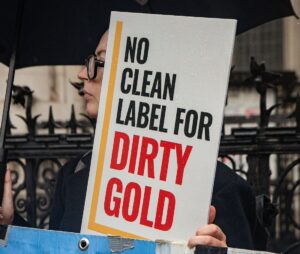
On the opening day of the trial, 7th October, protesters gathered outside the court with a clear message for London’s gold market: End Dirty Gold.
The case has been brought by the families of two young Tanzanian men who allege their loved ones were unlawfully killed by police guarding the North Mara gold mine in Tanzania in 2019. The trial will ask, can the LBMA be held legally accountable for alleged failures in its responsible-sourcing system?
Here is what happened in Week 1:
The claimants’ opening arguments
The claimants, represented by a legal team led by former Attorney General Dominic Grieve KC, made several central arguments:
- A long history of violence: The claimants highlighted years of reported killings, shootings and serious abuses at North Mara. They argued that security forces routinely used disproportionate force against local people searching for gold, including those who were unarmed and fleeing.
- The origins of “responsible gold”: The claimants traced the LBMA’s Responsible Gold Guidance (RGG) to the US Dodd-Frank Act, which introduced new reporting requirements for US-listed companies using gold and other minerals.
- Flawed oversight and “vacuous” reports: The claimants alleged that the LBMA failed to enforce its responsible-sourcing standards, accepting what their barrister called “vacuous” reports and inadequate audits.
- “Cloaking” human rights abuses: A central, repeated argument was that the LBMA’s continued certification of MMTC-PAMP, the Indian gold refiner processing North Mara gold and part of the Swiss-based MKS PAMP Group, helped “cloak” the violence, reassuring international buyers, and discouraged further scrutiny, thereby allowing abuses to continue. Major companies, including Apple, Canon and Hewlett-Packard, have listed MMTC-PAMP in their gold supply chains.
- The power to demand change: The claimants argued that the LBMA could have suspended, or threatened to suspend, MMTC-PAMP’s accreditation, to pressure the refiner and mine owners to address the violence and prevent the two deaths, but that it did not do so.
- Conflicts of interest: The claimants argued that close relationships between the LBMA and the companies it oversees undermined independent scrutiny. They highlighted the “extraordinary degree of undue influence from MKS PAMP Group” in shaping the responsible-sourcing rules, and the role of LBMA board members linked to MMTC-PAMP and Barrick. On Day 2, the judge permitted an amendment to the claimants’ case adding MKS PAMP to the pleadings.
- A legal duty of care: The claimants argued that the LBMA had a legal responsibility not to put people at risk through its certification decisions. They also relied on the “interference principle”, recognised by the UK Supreme Court in the 2024 Tindall case, which recognises that an organisation may be legally responsible if its actions discourage others from preventing harm. The claimants argue that the LBMA’s certification discouraged gold buyers from investigating abuses at North Mara and demanding change.
What did the LBMA argue in its defence?
The LBMA’s lawyers, represented by a legal team led by Geraint Webb KC, expressed condolences to the families but strongly denied legal responsibility for the deaths. Their central arguments were:
- The LBMA certifies refiners, not mines: Its rules require refiners to have appropriate systems for investigating supply-chain risks, assessed by independent auditors. The LBMA does not certify individual mines or guarantee gold is free from human rights abuses.
- No control over the police or mine: The LBMA argued that the alleged unlawful killings involved Tanzanian police, over whom neither it nor the refiner had control. It did not own, operate or supervise North Mara.
- Would LBMA action have changed anything? The defence disputed that suspending MMTC-PAMP would have prevented the deaths. It argued that North Mara could have sold gold through other markets and that suspension would not necessarily have changed police conduct.
- Engagement, not abandonment: The LBMA argued that international guidance encourages companies to work with higher-risk suppliers to improve conditions, rather than automatically cutting commercial ties. Removing responsible refiners, it said, could make matters worse.
- Limits to legal responsibility: The LBMA rejected the duty-of-care and interference arguments, warning that such obligations could make certification bodies liable for actions by third parties beyond their control.
The first witness takes the stand
Catherine Coumans of MiningWatch Canada, which has published numerous reports documenting alleged human rights abuses at North Mara, was the first witness to give evidence on 8 October.
The LBMA’s barrister Webb questioned her about investigations, witness interviews and research methods. Coumans defended the organisation’s approach, including measures to protect witnesses from reprisals. The court also heard about community concerns over the mine’s grievance mechanism.
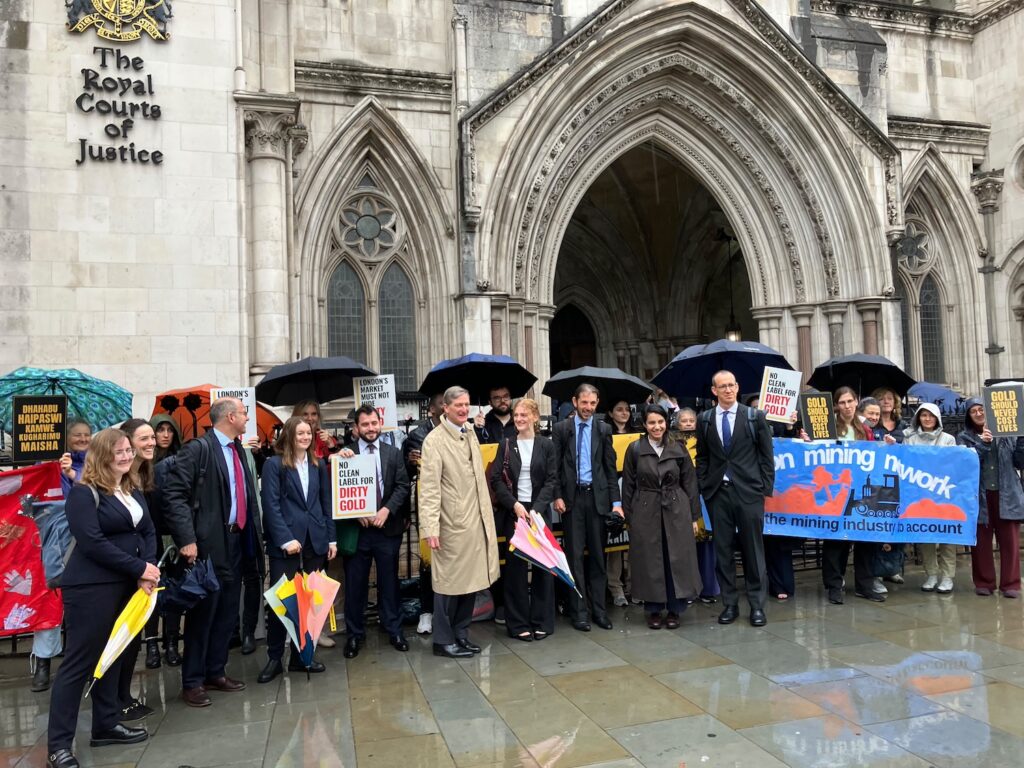
Photo: The legal team representing the Tanzanian claimants pause at the steps of the court before entering.
The claimants’ barrister is former Attorney General Dominic Grieve KC.
Why this case matters
At its heart, the case asks whether a powerful industry body can be held legally accountable when its responsible-sourcing system allegedly fails to protect people from serious human rights abuses.
We’ll be sharing weekly updates from the trial, running from 7 October to 20 November.
Follow us as we examine what this case could mean, not just for gold sourcing, but for industry certification schemes and global supply chains more broadly.