Lisez ceci en français.
Residents take Zijin-controlled COMMUS mine to Kolwezi court in a case that could pave the way for other communities seeking justice for widespread mining pollution
One of the most ambitious legal challenges yet brought by Congolese residents over industrial mining pollution had its first public hearing today at the Commercial Court in Kolwezi, Democratic Republic of Congo (DRC). The pioneering lawsuit, brought by residents living alongside the vast copper and cobalt mine operated by Compagnie Minière de Musonoie Global (COMMUS), seeks to hold both the company and Congolese state authorities accountable for widespread environmental contamination.
The 27 claimants – including 8 children – are suing COMMUS, controlled by Chinese giant Zijin Mining, for air, water and soil pollution, which they say is destroying their health and disrupting their daily lives. The lawsuit also targets the Congolese state and the Congolese Environment Agency (ACE), which residents accuse of failing to properly monitor the mine and enforce environmental laws.
The lawsuit is an important test case of the DRC’s strengthened mining law, particularly Article 285 bis, which reverses the burden of proof by requiring mining companies to show that environmental harm to local communities was not caused by their operations if they want to avoid liability. If successful, the case could pave the way for other communities living near industrial mines to seek justice.
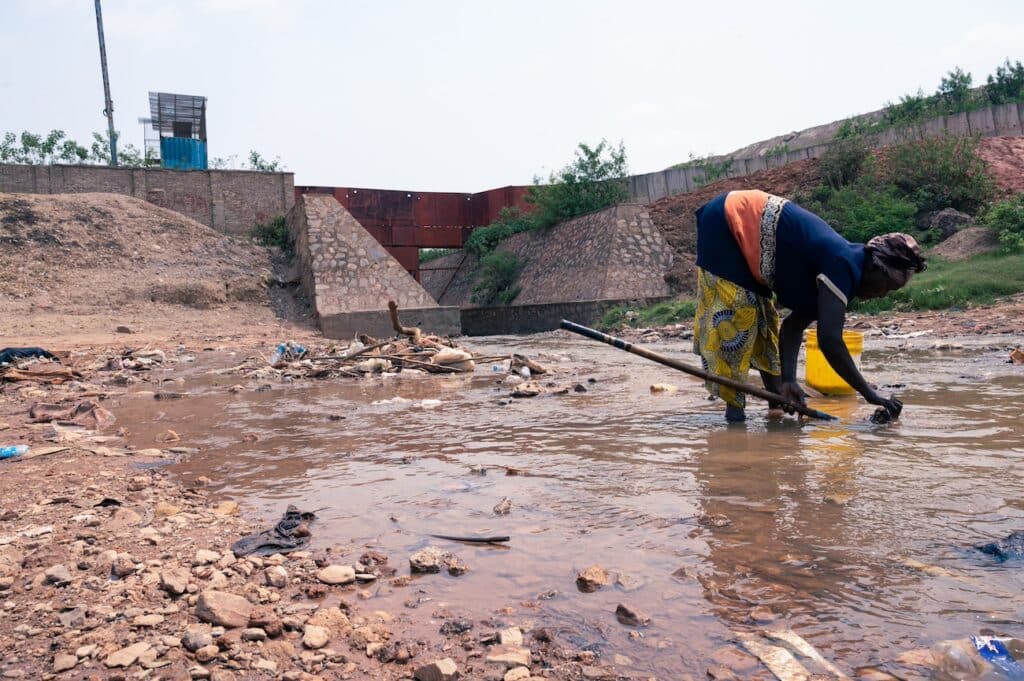
Madam Marie [not her real name] mother of eight and one of the claimants, said: “COMMUS found us already living here. Before, we lived well. We used to fish, vegetables grew naturally along the stream, and we used the water for cooking and washing. But COMMUS polluted our stream, blocked it and diverted it elsewhere. Now we can no longer find fish because the water contains acid, and washing with it causes skin problems. When you go outside to enjoy the fresh air, you feel something irritating your face. We have asked the government to come and see what is happening, but we have never received any help.”
The first hearing, held earlier today, focused on procedural issues. The merits of the case have yet to be examined. The case continues.

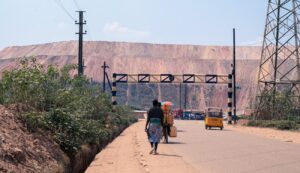
Mine tailings located near the main road in the Golf Tshabula neighbourhood, Dilala Municipality, Kolwezi, in Lualaba Province, DRC ©2026 RAID/Lydia Katanga
Living in the shadow of a vast mine
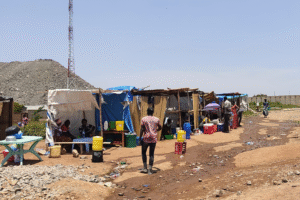
The COMMUS mine is a sprawling industrial complex that is embedded into the daily lives of communities in Kolwezi. Homes stand close to mountains of mining waste dumps, ore stockpiles and processing facilities, with little separation between heavy industry and the places where families live and children play and study. In December 2023, a breach at COMMUS’s tailings dam flooded a nearby artisanal mining site and damaged homes, roads and a school.
Residents say they have been kept in the dark about the risks posed by the mine. They have not been given access to COMMUS’s environmental and social impact assessment (ESIA), a key document which should explain the potential dangers of its operations and the measures the company is required to take to protect nearby communities. Congolese mining law requires that such documents are publicly available.
Scientific studies reveal serious pollution
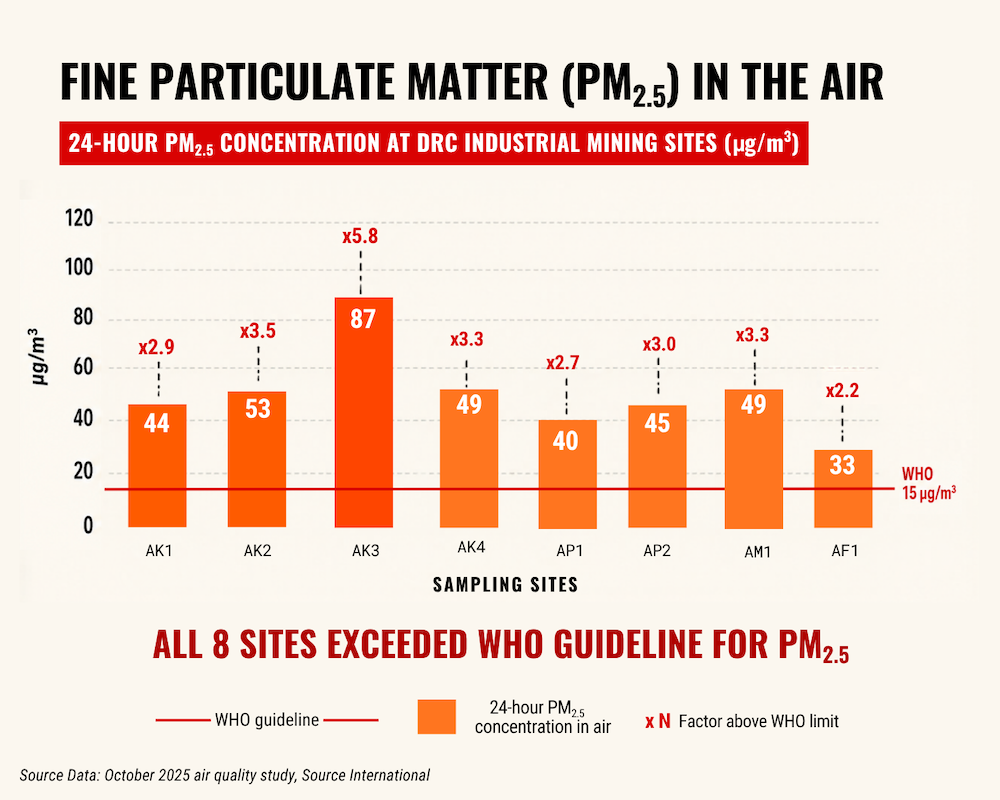
Independent scientific studies commissioned by UK-based corporate watchdog RAID and Congolese human rights organisation AFREWATCH, published in June 2026, found alarming levels of air pollution and water pollution near COMMUS and other industrial mines in the region. At the Galaxy school, located near the COMMUS mine and attended by around 1,500 children, the scientists from Source International recorded fine particulate air pollution (PM2.5) at almost three times the World Health Organization (WHO) recommended daily limit. The dust contained elevated levels of copper and cobalt, with a chemical fingerprint clearly pointing to industrial mining as its source. Prolonged exposure to this type of pollution is linked to cancer, respiratory disease and impaired lung development in children.
A permanent air quality monitor installed by Source International scientists in September 2026 in Musonoie, a neighbourhood near the COMMUS mine, has revealed sustained, dangerously high levels of fine particulate pollution. During September and October, PM2.5 concentrations averaged more than five times the WHO’s recommended daily limit, with one day’s average reaching eight times that level.
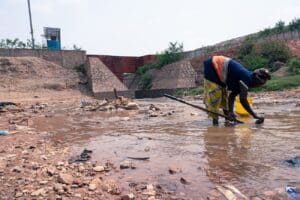
The scientists also found highly acidic water and elevated concentrations of metals in a community well near COMMUS’s tailings storage facility.
“COMMUS found us already living here. Before, we lived well. We used to fish, vegetables grew naturally along the stream, and we used the water for cooking and washing. But COMMUS polluted our stream, blocked it and diverted it elsewhere. Now we can no longer find fish because the water contains acid, and washing with it causes skin problems. In the evening, there is usually a pleasant breeze, but when you go outside to enjoy the fresh air, you feel something irritating your face. We have asked the government to come and see what is happening, but we have never received any help. There is still no solution.”
– Local resident and claimant
Residents interviewed by RAID and AFREWATCH, described coughing, nosebleeds and headaches and other health problems they associate with pollution from the mine. Some also reported birth defects, while women described menstrual disorders and other reproductive health concerns. The findings raise serious questions about the environmental and public health risks facing communities living alongside industrial mines and whether enough is being done to protect them.
“Communities living alongside these mines have raised concerns for years, but too often they have received little or no protection,” said Jean Pierre Lwamba, Human Rights Director of AFREWATCH. “Now, with independent scientific evidence to support their concerns, residents are taking their fight for justice to court. They want pollution cleaned up and further harm prevented. They should not have to accept contamination as the inevitable price of mining.”

Holding mining companies accountable
The claimants are asking the court to hold COMMUS, the Congolese state, and its environmental agency ACE, jointly responsible for the harm they say has been caused by mining pollution. They are seeking nearly US $1.3 million in compensation for health problems, medical expenses, lost income and emotional distress, as well as US $5 million to restore the damaged environment.
But the lawsuit goes beyond compensation for past harms. The residents also want the court to order COMMUS to stop harmful pollution, clean up contaminated water and land, provide safe drinking water, and fund an independent study into the health impacts on communities living near to the mine. They are also demanding stronger government oversight and public access to key environmental studies and pollution monitoring data.
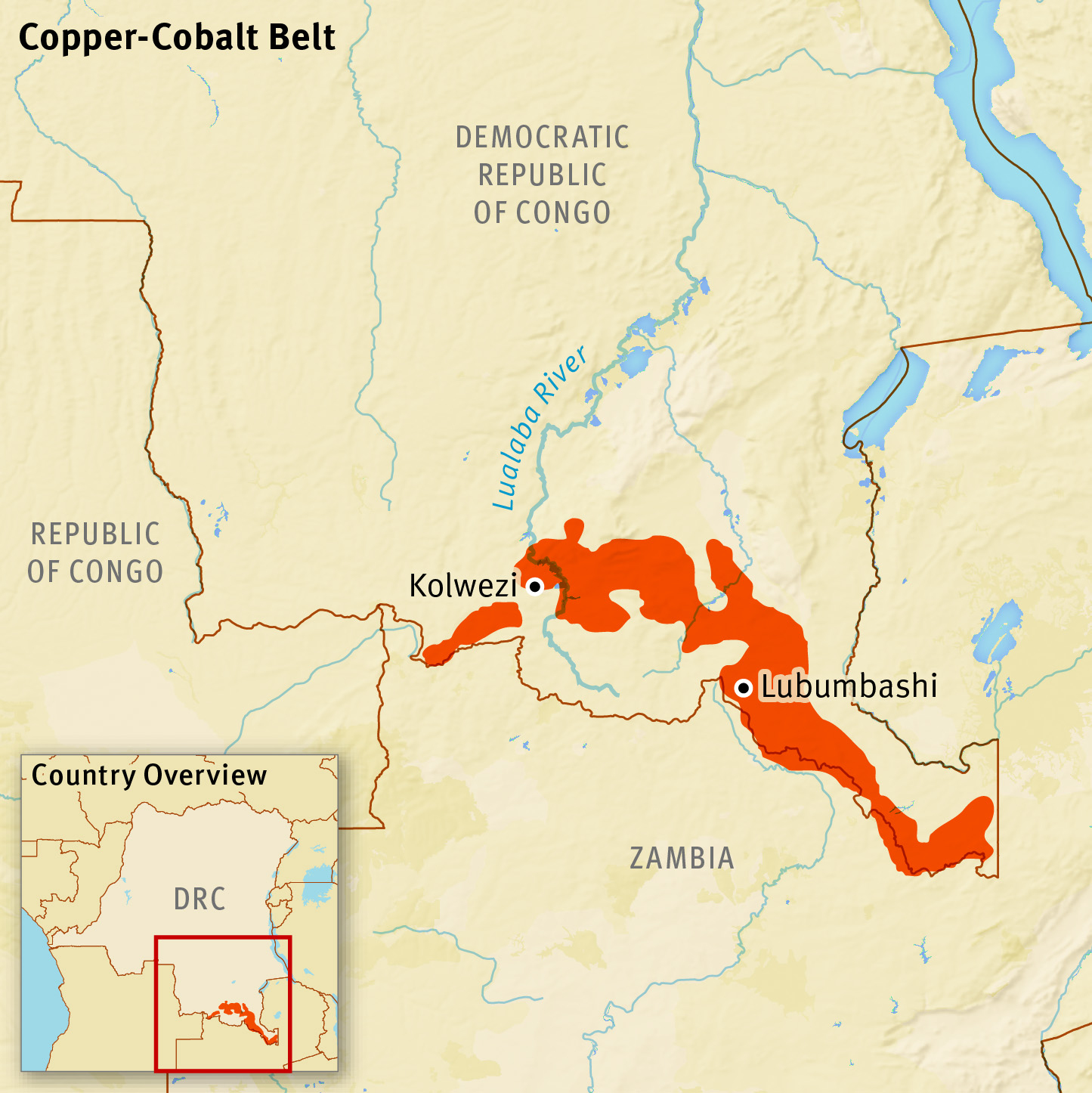
The case could have far-reaching implications for those outside Kolwezi. Across the DRC’s copper and cobalt belt, communities are living alongside pollution from large industrial operations, often with limited access to information about it impact on their health and livelihoods, and few effective ways to seek redress when things go wrong.

Mine tailings from the COMMUS mine as seen from Galaxy School in the Musonoie neighborhood, Kolwezi, Lualaba Province, DRC ©2026 RAID/Lydia Katanga
In a July 2026 response to RAID and AFREWATCH, COMMUS maintained that its operations comply with Congolese environmental regulations and that its own monitoring shows that the air quality “generally” meets applicable standards. The company argued that pollution in Kolwezi has multiple potential sources, including natural geological conditions, historical mining and other industrial activities. It pointed to measures it has taken to control dust and manage wastewater, and pledged further independent monitoring and engagement with communities.
“The clean energy transition cannot be built on polluted communities,” said Anneke Van Woudenberg, Executive Director of RAID. “As the world races for Congo’s copper and cobalt, the people living alongside these mines are demanding that their rights matter too. Rather than waiting for companies and governments to protect them, they are taking their fight for justice into the courtroom.”
The residents are represented by MUN Consulting Law Firm, a new Congolese law firm established to help communities affected by mining seek justice. RAID and AFREWATCH are supporting the legal action, but are not parties to the proceedings.
For further information, please see:
- RAID, AFREWATCH and Source International, A deadly chemical trail: New scientific evidence reveals industrial-scale pollution at DRC’s copper-cobalt mines, June 2026.
- RAID and AFREWATCH, Beneath the Green: A Critical Look at the Environmental and Human Costs of Industrial Cobalt Mining in DRC, March 2024.
- Visit all of our DRC projects here.

Further testimony from Madam Marie, a claimant in the COMMUS lawsuit
Madam Marie (not her real name) is a mother of eight children who lives near the COMMUS mine in Kolwezi. She is one of the residents bringing legal action against the mining company and the Congolese state.
“I bought my plot of land in 2008. I built my house and moved into it in 2010, but COMMUS arrived here in 2015. In other words, COMMUS found us already living here.
Before that, we lived well. There used to be a small stream flowing from the lake towards our neighbourhood. We used to fish there, and there were fish. Certain vegetables also grew naturally along the banks of the stream. But when COMMUS arrived, it polluted our small stream. Then it blocked the stream and diverted it elsewhere.
Later, they installed pipes to take water from the lake to their factory. They also installed other pipes to carry water from the factory back into the lake. When the water from the factory flows back into the lake, it is no longer possible to find fish because that water contains acid. The vegetables that used to grow naturally around the lake no longer grow there either.
For example, there used to be a vegetable here called mulapalala, which grew beside the lake. But it only grows near water sources that are not acidic. We also used to rely on the lake water for household activities, such as washing and cooking. But we no longer use it because, if you wash with that water, you develop skin problems.
If you come here to our neighbourhood at around five in the afternoon, or in the morning between seven and eight, you will notice vapour rising from COMMUS’s storage area. It looks like steam coming from a pot on a fire. At around five in the afternoon, there is usually a pleasant breeze. But when you go outside to enjoy the fresh air, you feel something irritating your face.
We have already asked the government to send experts to verify what we are saying. If we are lying, let the state bring experts to see what is happening. But we have never received any help from the state.
We have already taken water samples to laboratories and shared the results with our authorities. They themselves confirmed the findings and told us: ‘You have already been harmed in so many ways.’ But despite all this, there is still no solution.”