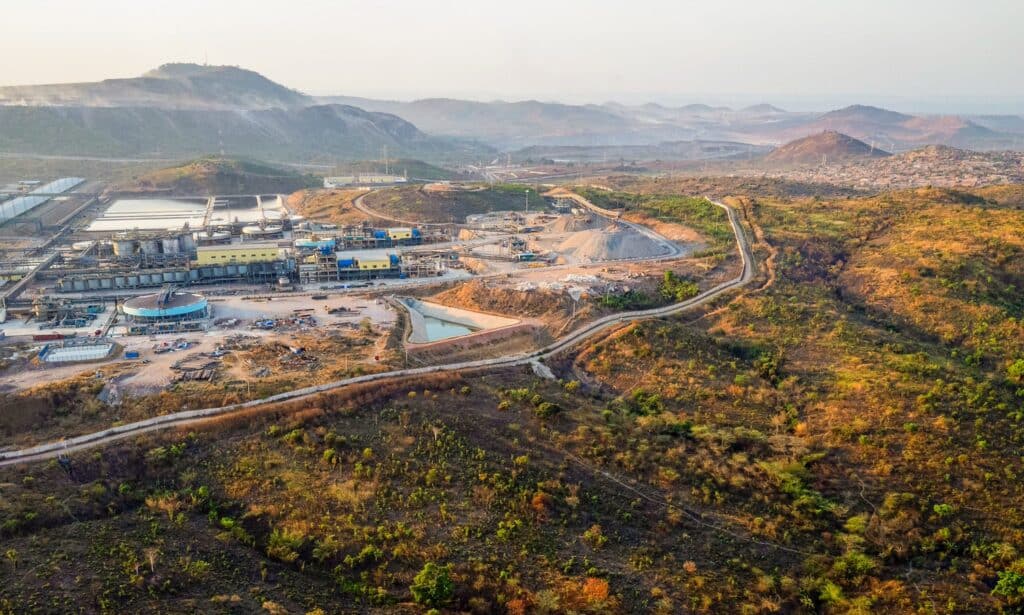
Featured photo: Aerial view of the 30k processing plant at TFM (Photo: Herman Kambala/Arete/EIA)
Lies dies auf Deutsch. / Lisez ceci en français.
30 workers and community members demand action over abusive labour conditions and toxic pollution at mines tied to the world’s largest EV battery maker, CATL
Today, 30 workers and community members affected by two major copper-cobalt mines in the Democratic Republic of Congo have filed a formal complaint with the German subsidiaries of CATL, the Chinese company that is the world’s largest electric vehicle battery maker. They are demanding action over serious labour abuses, toxic pollution and other harms linked to the mines.
The complaint describes workers facing excessive hours, inadequate pay, discrimination and unsafe conditions. It includes the grievances of communities living near the mines, who report serious water and air pollution threatening their health and livelihoods. Some families have been displaced without adequate compensation, while those who raised concerns have faced reprisals.
“We developed rashes all over our bodies and started coughing,” said one complainant who formerly lived near the lime plant at the Tenke Fungurume mine (TFM). “Whenever the plant was running, the whole village was covered in dust! We also felt dizzy, as if we had drunk alcohol.”
Supported by six Congolese and international human rights and environmental organisations, the complaint was submitted under Germany’s Supply Chain Due Diligence Act (LkSG), which requires German companies to take steps to identify, prevent and address human rights abuses in their supply chains. It calls on CATL’s German subsidiaries, collectively referred to as “CATL Germany”, to use their influence to address the harms.
CATL, a market-leading giant in the production of batteries and large-scale energy storage, supplies battery cells to major European automakers, including the Volkswagen Group, Mercedes-Benz and BMW. In the first half of 2026, CATL accounted for 44.3% of Europe’s EV battery market, supplying battery cells made in both China and Europe. In Germany, CATL operates a battery plant near Arnstadt in Thuringia with 1,700 employees.
The complaint concerns the Kisanfu (KFM) and Tenke Fungurume (TFM) mines, both vast industrial mines located in DRC’s copper-cobalt belt, which are operated by Chinese mining group CMOC. CATL has extensive financial ties to the mines, including a nearly 25% indirect stake in CMOC and a joint investment in KFM. Evidence from corporate filings also indicates that copper and cobalt from the mines enter CATL’s battery supply chain.
“We developed rashes all over our bodies and started coughing. Whenever the plant was running, the whole village was covered in dust! We also felt dizzy, as if we had drunk alcohol.”
– Local resident
Workers report gruelling shifts, threats; findings indicate possible forced labour
The complaint includes 21 workers from KFM and TFM, including direct employees and subcontracted workers. Workers at KFM report shifts of up to 14 hours a day, sometimes working for up to 26 consecutive days. They describe threats of dismissal or other penalties for refusing overtime. Some report earning just US$5–6 a day, below Congo’s statutory minimum wage.
Workers also describe exposure to hazardous dust and chemicals without adequate protective equipment, and limited access to medical care, particularly for subcontracted workers. Many report having no effective union representation and facing intimidation or retaliation for raising concerns about their working conditions.
These accounts raise serious concerns about possible forced labour and breaches of Congolese labour law. Previous investigations have documented similar labour abuses at TFM and other industrial mines in Congo. In 2024, the US Department of Labor also identified evidence of forced labour in Congo’s cobalt production, including at industrial mines.
Communities report toxic air pollution and serious health problems
Nine residents living near TFM have also joined the complaint, raising serious concerns about pollution and its impact on their health and livelihoods. Residents of nearby communities report persistent coughing, nosebleeds, breathing difficulties and other health problems.
Research published by EIA and PremiCongo in March 2026 provides further evidence of toxic air pollution around TFM. Measurements near the mine’s 30K processing plant recorded sulphur dioxide (SO₂) concentrations exceeding World Health Organization (WHO) guidelines, while an examination of more than 1,200 medical records documented serious respiratory illnesses, including patients coughing up blood. Separate testing in nearby residential areas found particulate matter (PM₂.₅ and PM₁₀) above WHO guidelines, with dust samples containing elevated levels of cobalt and copper.
The complaint also describes displacement without adequate compensation. In May 2026, 11 community members were arrested after returning to their former village to protest a resettlement process they judged unjust, with eight subsequently sentenced to prison terms.
Company responses
TFM and CMOC have previously disputed allegations of environmental and labour abuses, while KFM’s 2025 human rights report found “no material indications” of forced labour but acknowledged continuing risks among contractors.
In previous statements, CATL has denied any connection to forced labour and reported that assessments of 54 suppliers found no forced labour, child labour or ecological damage in violation of its sustainability policies.
In July, the German government proposed limiting the binding obligations of its LkSG supply chain law to larger companies, a change that could leave CATL Germany outside the law’s scope. Until such changes take effect, however, the company is obliged to comply with the existing law.
“The German law’s requirements are clear: companies must take reports of human rights abuses and pollution impacting communities in their supply chains seriously and act on them”, said the group of civil society actors supporting the complaint. “CATL Germany should promptly investigate this complaint, engage with those who submitted it, and use its influence to address the abuses and pollution they describe.”
The civil society groups who have submitted the complaint alongside the workers and community members include: UK corporate watchdog, RAID; African Resources Watch (AFREWATCH) DRC and International, PremiCongo, the Centre d’Aide Juridico-Judiciaire (CAJJ), and the Environmental Investigation Agency US (EIA US). The complainants have requested that CATL Germany provide a substantive, reasoned response within six weeks of receiving the complaint, outlining how it is investigating the reported abuses and environmental harm, what immediate measures it has taken and what further steps it plans.
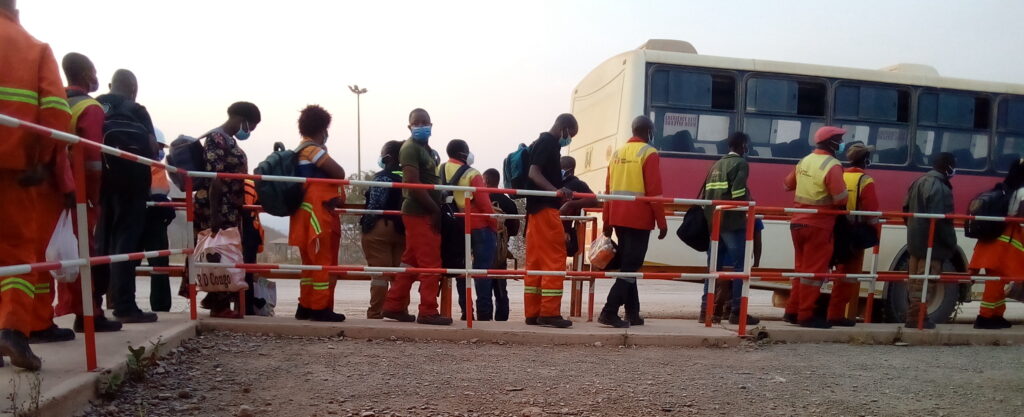
TFM workers boarding a bus to travel to the mine site, Fungurume ©2021 RAID
Further background
For more information on CATL’s operations and supply-chain links, the evidence of abuses and company responses, and the legal framework, please see the background below.
The German supply chain law (LkSG) and other legal requirements
The LkSG Act requires companies to establish an internal complaints procedure through which affected people and civil society groups can report actual or potential human rights abuses and environmental harm in the company’s operations and supply chain. Where a complaint provides factual indications of possible violations at indirect suppliers, the company must, “without undue delay”, examine the reported abuses and develop and implement a plan to prevent, stop or minimise them.
Affected people can also submit a complaint to Germany’s Federal Office for Economic Affairs and Export Control (BAFA), the government authority responsible for enforcing the LkSG. BAFA can investigate companies’ compliance with their legal obligations, either in response to complaints or on its own initiative. Where violations are found, it can order corrective measures or impose fines.
The Act currently applies to companies based in Germany or with a German branch that employ at least 1,000 people in the country. The federal government plans to narrow its scope to align with revised EU rules, which will apply to EU companies with more than 5,000 employees and annual net turnover exceeding €1.5 billion. German civil society groups have criticised the proposed change, estimating that it would exclude about 95% of companies – such as CATL Germany – currently under the LkSG law, leaving only around 150 companies established in Germany covered.
From 18 August 2027, the EU Batteries Regulation will require major companies supplying batteries to the EU market, including CATL, to identify, prevent and address human rights and environmental risks linked to materials, including cobalt.
Additional evidence on abuses, and company responses
The community accounts described in the complaint echo recent findings by RAID and AFREWATCH, EIA US and PremiCongo, scientists from Source International and the University of Lubumbashi, and the Mazingira Pour Tous coalition.
The mining companies’ own 2025 human rights reports also identify continuing concerns about working conditions, safety, security practices and access to effective complaints procedures for workers and communities. TFM discusses how land acquisition and resettlement can harm people’s rights and livelihoods, while KFM highlights potential harm linked to arrests, detention and the use of security dogs, alongside community concerns about water quality, water availability and farming.
In a December 2024 response to research on forced labour in Congo’s cobalt sector, CMOC said that TFM had a “mature management system to prevent and mitigate human rights risks, including child labor and forced labor”.
In 2024, TFM became the first mine in Africa to receive the Copper Mark, a voluntary industry label awarded after an assessment of environmental, social and governance practices. KFM received the same label in August 2026, although eight assessment criteria were only partially met and an improvement plan remains in progress. Both mines also hold international certifications for their environmental and workplace health and safety management systems. These credentials are at odds with the evidence of abuses and pollution documented in the complaint.

An external view of a maternal health centre in Fungurume, DRC (Photo: Herman Kambala/Arete/EIA)
CATL in Germany and Europe
Headquartered in the city of Ningde, south-east China, Contemporary Amperex Technology Co. Limited (CATL) makes nearly 40% of the world’s batteries for electric vehicles, and now aims to become a market leader for battery energy storage systems.
The Thuringia plant produces battery cells – the units that store energy – and assembles them into larger units called modules for electric vehicles. Environmental permits for the plant provide for the use of copper- and cobalt-containing materials in battery production: thin sheets of copper are used to make battery components, and the plant is authorised to store up to 2,205 tonnes of a powder containing lithium, nickel, cobalt and manganese.
CATL also distributes Chinese-made battery cells to the European market through its “Central Distribution Centres” in the German states of Thuringia and Saxony-Anhalt. These centres receive cells from CATL’s factories in China, check and repackage them, and send them to customers.
These operations form part of CATL’s wider supply network for European automakers. CATL supplies cobalt-containing battery cells to major German carmakers, including BMW, Mercedes-Benz, and Volkswagen Group brands such as Audi and Porsche. Some of these batteries are manufactured at the Thuringia plant.
CATL considers Europe an “important market” and describes Arnstadt as its “EU headquarter”. Beyond Germany, the company also makes battery modules in Debrecen, Hungary, where it began trial production of battery cells in September 2026. It is also building a battery factory in Zaragoza, Spain, jointly with carmaker Stellantis. The lithium-ion batteries planned for these factories all use copper, but not all of them contain cobalt: the Spanish plant will make cobalt-free batteries, while the Hungarian plant is intended to produce both types.
CATL’s shareholding and board links to CMOC
KFM has become the world’s largest cobalt mine. Together, KFM and TFM produced approximately 44% of the world’s mined cobalt in 2025, as well as more than 740,000 tonnes of copper.
CATL has significant corporate links to CMOC, the Chinese mining company that operates the TFM and KFM mines, through both shareholding and board representation. As of 30 June 2026, CATL indirectly held 24.91% of CMOC through its subsidiary Luoyang Times Resources Holdings, making it CMOC’s second-largest shareholder. Two CATL executives also sit on CMOC’s board, one as vice-chair.
CATL’s links with KFM
In April 2021, CATL and CMOC announced a “strategic partnership” to develop KFM together. Through their subsidiaries, CMOC owns 75% and CATL 25% of KFM Holding, which holds 95% of the mine (the Congolese state holds the remaining 5%). The companies agreed to share project funding and rights to buy the mine’s future copper and cobalt output in proportion to their ownership.
Two supply agreements signed in December 2024 connect KFM’s mining operations to CATL’s battery business. One covers sales of KFM’s copper and cobalt to other companies within the CMOC group. The other covers sales of metals, including copper, cobalt, nickel and lithium, from CMOC to the CATL group.
Originally spanning 2025-2027, these arrangements are set to continue under replacement agreements approved by CMOC’s board in July 2026 and its shareholders in August. The replacements would extend the arrangements through the end of 2028 and raise the maximum annual value of the transactions.

Mine worker uniforms for sale on a street in Lualaba province, DRC ©2025 RAID
Evidence points to TFM as an additional supplier to CATL
CMOC’s supply arrangements with CATL extend beyond KFM. In a July 2026 circular, CMOC states that the copper and cobalt it sells to CATL do “not necessarily” come from KFM. The evidence points to TFM as the likely source of supplies from outside KFM. TFM’s copper and cobalt are marketed through IXM, CMOC’s metal-trading subsidiary.
According to CMOC management, quoted in the circular, increased production at TFM and KFM had met the CMOC group’s copper and cobalt needs, without purchases from independent third parties in 2025 or in 2026 up to that point.
Looking ahead, the circular says CATL’s expected cobalt demand exceeds the amount KFM is allowed to export under quotas set by the Congolese government. CMOC plans to meet that shortfall through IXM, providing a route for further supplies from TFM.
TFM’s relationship with European and US markets
TFM’s copper is also earmarked for the US market. In January 2026, Gécamines – Congo’s state-owned company – announced that it would purchase 100,000 tonnes of TFM’s copper production for sale to the US market, with support from commodities trader Mercuria. In February, the US International Development Finance Corporation (DFC) reported that the Gécamines-Mercuria venture had begun shipping copper committed to the United States. More recently, on 15 October, Mercuria announced that 12,000 tonnes of Congolese copper had been delivered to Project Vault, a US strategic minerals stockpile, under the broader Gécamines-Mercuria arrangement.
The March 2026 investigation by EIA identified Belgian materials company Umicore as a major buyer of cobalt from CMOC’s TFM mine, with likely downstream links to European automakers including BMW, Mercedes-Benz and Volkswagen.
New investigation raises concerns about CATL’s nickel supply chain
A separate investigation published on 16 October 2026 by Voxeurop, The Guardian and other European media outlets, raised further concerns about CATL’s mineral supply chains. It traced nickel from Indonesian mines linked to widespread deforestation on lands inhabited by Indigenous communities to a Chinese battery materials producer that supplies CATL.

Aerial view of the 30k processing plant at TFM (Photo: Herman Kambala/Arete/EIA)
Further reading
On the German Supply Chain Due Diligence Act (LkSG) and its complaint procedures
- European Center for Constitutional and Human Rights (ECCHR), Brot für die Welt and Misereor, Two years of the German Supply Chain Act – An interim assessment, May 2025.
On labour conditions at TFM and other industrial mines in Congo
- RAID and CAJJ, Workers’ Rights Under Scrutiny: An Update on Labour Conditions in the DRC’s Industrial Mines, July 2025.
- RAID and CAJJ, The Road to Ruin? Electric Vehicles and Workers’ Rights Abuses at DR Congo’s Industrial Cobalt Mines, November 2021.
On pollution, displacement and other impacts on fenceline communities at TFM and other industrial mines in Congo
- EIA US and PremiCongo, Toxic Transition: How the World’s Largest Cobalt Producer Has Allegedly Poisoned Communities for Years, March 2026.
- EIA US, AFREWATCH and other civil society groups, “11 Community Leaders Jailed in DRC: The Unacceptable Cost of Speaking Truth to Tenke Fungurume Mining”, May 2026.
- Mazingira Pour Tous, in collaboration with Resource Matters, Air pollution in Fungurume: Is Manomapia dying under the 30K plant?, September 2026.
- RAID, AFREWATCH and Source International, A deadly chemical trail: New scientific evidence reveals industrial-scale pollution at DRC’s copper-cobalt mines, June 2026.
- RAID and AFREWATCH, Beneath the Green: A Critical Look at the Environmental and Human Costs of Industrial Cobalt Mining in DRC, March 2024.