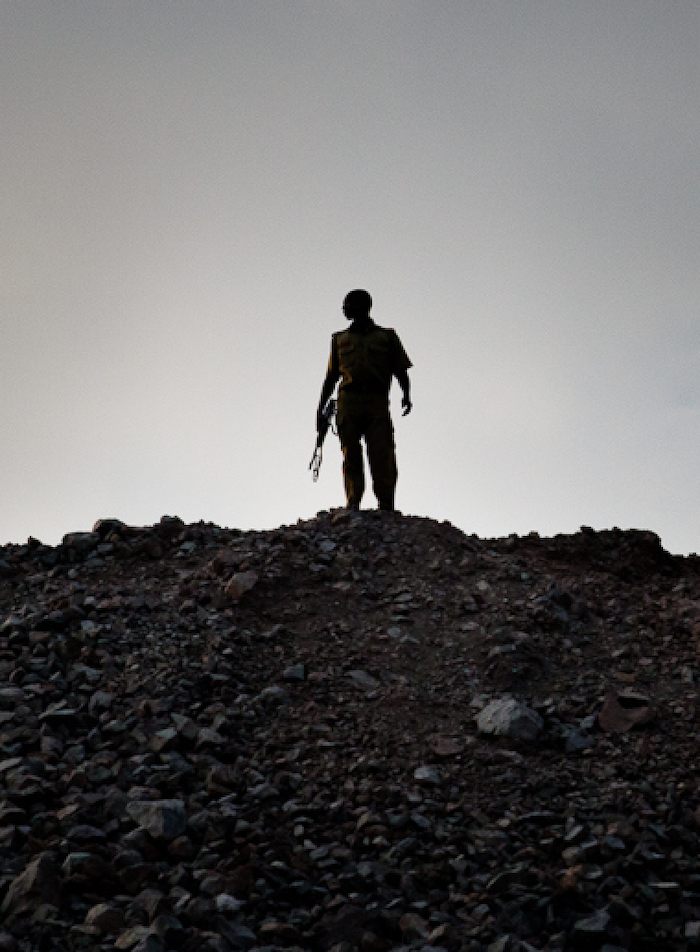
On 27 November 2025, the Ontario Court of Appeal will hear a high-stakes human rights case against Canadian mining giant Barrick. The appeal has been brought by Tanzanian victims of alleged killings, shootings and torture linked to Barrick’s North Mara gold mine in Tanzania.
At issue is a pivotal question for Canadian law: when can a multinational parent company be held to account in its home country for serious human rights abuses committed abroad?
In 2024, the Ontario Superior Court dismissed the case, ruling that Tanzania would be a more appropriate forum for the proceedings. The plaintiffs are now challenging that decision. The outcome of this appeal could set an important precedent for how Canadian courts handle transnational human rights cases, and whether those harmed by Canadian companies overseas can seek remedy in the country where corporate power is centred.
For further background on human rights issues at the North Mara gold mine, see RAID’s investigations here.
Who is Barrick?
Barrick is one of Canada’s largest mining companies and a major global producer of gold and copper. Headquartered in Toronto and listed on the Toronto Stock Exchange, it remains a flagship of Canada’s mining industry. Barrick’s operations stretch across multiple continents, with large-scale mines and joint ventures in North America, South America, Africa and Asia, including a major copper-gold project in Pakistan.
Given Barrick’s corporate base in Canada, the plaintiffs argue that Canadian courts should be able to scrutinise the company’s conduct when serious human rights abuses are alleged at Barrick’s mining sites oversees.
What is Barrick being sued for?
The case concerns allegations of killings, shootings and torture committed between 2021 and 2023 by members of the Tanzanian Police Force assigned to provide security at Barrick’s North Mara gold mine. Local residents often refer to these officers as “mine police”. Although they are state police, they operate under an arrangement to provide security at the mine, where their actions directly affect surrounding communities.
While violence linked to mine security at North Mara has been documented for more than a decade, the Canadian case focuses on recent incidents that occurred after Barrick assumed operational control of the mine in September 2019. The plaintiffs argue that the police abuses formed part of a continuing pattern and that Barrick, as the Canadian parent company, should be held responsible because of the way it designed, directed and oversaw security and human rights practices at the mining site.
Who are the people bringing this case?
The case has been brought by 29 members of the Indigenous Kurya community – the plaintiffs – who live in villages around the North Mara gold mine in northern Tanzania. They include people who were seriously injured or tortured during mine-related security operations, and family members of community members who were killed. Together, they are seeking accountability in Canada for violence they allege was carried out by police assigned to provide security at the mine.
They are represented by Canadian law firms CFM in Vancouver and Phillips Barristers in Toronto.
Why is this case being heard in Canada?
The legal action has been brought in Ontario because Barrick is a Canadian company headquartered in Toronto. The plaintiffs argue that a corporation should be accountable in the country where it is based and that Canadian courts have both the authority and the responsibility to scrutinise those actions where serious harm is alleged.
However, the question of the appropriate legal forum, and whether this case should be heard in Canada or Tanzania, became central to the 2024 dismissal and is now at the heart of the 2025 appeal. In essence, the Court of Appeal must decide whether accountability for alleged violence linked to a Canadian-based company can be pursued in Canada, or whether the proceedings should take place in Tanzania despite the parent company being headquartered elsewhere.
What is Barrick’s position?
Barrick disputes that the case should be heard in Canada. It argues that the alleged abuses were carried out in Tanzania by members of the Tanzanian Police Force, a state institution that it does not control or supervise. Barrick maintains that because the police are part of a sovereign state, the company cannot be held responsible for their actions.
Barrick also emphasises that its presence in Ontario is limited, noting that fewer than 55 employees work at its Toronto office and that none of them are responsible for managing or overseeing the North Mara mine.
On the question of forum, Barrick argues that Tanzania, not Canada, is the appropriate place for the case to be heard. It asserts that key witnesses and evidence, including police officers, community members, medical staff and mine employees, are all located in Tanzania, and that it would therefore be unfair to conduct the trial in Ontario. This argument, known as forum non conveniens, is central to the appeal. Barrick’s statement on its position can be found here.
What is the timeline of the case so far?
- November 2022 – Case filed in Ontario against Barrick by Tanzanian community members.
- October 2024 – First hearings held at the Ontario Superior Court of Justice on Barrick’s motion to dismiss or stay the case.
- November 2024 – Case dismissed on the grounds that the Ontario court lacks jurisdiction. The plaintiffs subsequently file an appeal challenging the dismissal.
- 27 November 2025 – Ontario Court of Appeal scheduled to hear the appeal.
Why was the case initially dismissed in 2024?
The case was dismissed in November 2024 by Justice Edward Morgan of the Ontario Superior Court of Justice. His decision did not address whether Barrick is responsible for the alleged violence at the North Mara mine. Instead, it focused solely on where the case should be heard.
Justice Morgan concluded that Ontario does not have jurisdiction, finding that Barrick’s presence in Toronto was too limited to justify hearing the case in Canada. He accepted Barrick’s argument that the mine is not operated or overseen from Ontario and that the alleged events took place in Tanzania. On these grounds, he ruled that any presumption of jurisdiction arising from Barrick’s Toronto office was rebutted.
He further held that, even if jurisdiction existed, Tanzania would still be the more appropriate forum including the fact that key witnesses and evidence – including police officers, local residents and mine personnel – are located there. As a result, the case was dismissed without any findings on whether the alleged killings, torture and injuries occurred, or whether Barrick bears responsibility.
Why have the plaintiffs appealed the decision?
The plaintiffs argue that this is a complex transnational human rights case in which they are seeking accountability from a major Canadian corporation in the courts of its home jurisdiction. They say the motion judge made errors of both fact and law in dismissing the case.
On jurisdiction, they point out that the judge incorrectly stated that Barrick’s headquarters are in Vancouver, when the company is headquartered in Toronto. They argue that this mistake led him to minimise Barrick’s presence in Ontario and to overlook the principle that a Canadian parent company can be held accountable in its home courts for harm linked to decisions made there.
They also argue that the judge treated the case as though it concerns only the conduct of individual police officers in Tanzania, rather than the role of the Canadian parent company. They reiterate that Barrick created, directs, implements and supervises the security and human rights systems at the North Mara mine, and that those systems enabled the violence they experienced.
As part of this argument, they point to a 2022 Memorandum of Understanding between Barrick and the Tanzanian Police Force, which requires police deployed to protect the mine to report the use of force and any human rights violations directly to the company. They note that this arrangement is supported by a “robust information system” that allows Barrick to oversee mine-site security from Canada, including through CCTV and mandatory police reporting requirements.
The plaintiffs are therefore asking the Court of Appeal to overturn the dismissal, recognise that Barrick can be held accountable in its home jurisdiction, and allow the case to proceed in Canada.
What happens next?
The case will be heard by a panel of three judges at the Ontario Court of Appeal on 27 November 2025, who will consider arguments from both sides. After the hearing, the Court will decide whether to uphold the lower court’s decision to dismiss the case or overturn it so that proceedings can continue in Ontario.
Will there be third-party interventions at the appeal hearing?
Yes. Amnesty International Canada has been granted leave to intervene as an amicus curiae (“friend of the court”). Amnesty’s submissions focus on access to justice and corporate accountability, arguing that Canadian courts should apply jurisdiction and forum rules in line with the right to an effective remedy for serious human rights abuses, recognised in international law. It emphasises that companies should not avoid scrutiny in their home countries simply because abuses occur abroad.
Barrick disputes Amnesty’s position, arguing that international human rights principles are irrelevant to the appeal and that the motion judge already considered access to justice in Tanzania.
Has the North Mara gold mine in Tanzania been the subject of similar cases internationally?
Yes. North Mara has repeatedly been the focus of legal claims arising from killings and injuries linked to mine security. Barrick and its former subsidiary have faced multiple lawsuits in the United Kingdom seeking remedy for alleged human rights abuses at the site.
In 2013, a group of Tanzanian community members who were injured or whose relatives were killed by mine security forces brought a case before the High Court in London against Acacia Mining, then majority-owned by Barrick. That case was settled in 2015.
A second group of Tanzanian claimants sued Acacia in the UK in 2020 over alleged abuses at North Mara between 2014 and September 2019. That case was settled out of court in 2024, with no public disclosure of the settlement terms. In both cases, the company resolved the claims without contesting them at trial.
A separate legal action was filed in 2022 in the UK against the London Bullion Market Association (LBMA), which oversees the world’s largest gold market. Unlike the earlier cases, this lawsuit does not target Barrick or Acacia directly. Instead, it alleges that LBMA bears responsibility because it certified gold from North Mara as being “responsibly sourced” despite evidence of serious human rights violations at the mine. This case is ongoing.
Taken together, these actions show that violence linked to mine security at North Mara has attracted repeated scrutiny and litigation over many years, with affected community members repeatedly seeking remedy through foreign courts.
How has Barrick’s control of the North Mara mine changed over time?
North Mara began commercial production in 2002 and was acquired by Barrick in 2006. From 2010 to 2019, it was operated by African Barrick Gold (renamed Acacia Mining in 2014), a UK-incorporated subsidiary in which Barrick held a controlling share. In 2019, Barrick bought out the remaining minority shareholders and brought the mine under its operational control through a joint venture with the Tanzanian government, Twiga Minerals.
Barrick describes North Mara as one of its “Tier One” assets, forming part of a gold complex whose production in 2024 exceeded half a million ounces. The mine is also of major economic importance to Tanzania, generating substantial tax revenues and foreign currency through the government’s share of earnings.
Why does this case matter for Canada?
Canada hosts nearly half of the world’s publicly listed mining companies, many operating in countries with limited legal protections and a history of serious human rights violations. Yet Canadian companies have rarely been held to account at home, and Canada has long been criticised for failing to implement stronger corporate accountability reforms. As a result, litigation has become one of the few avenues through which communities harmed by Canadian multinationals can seek remedy.
Amnesty International argues that Canadian courts should interpret jurisdiction in line with the right to an effective remedy, drawing on Nevsun Resources Ltd. v. Araya, where the Supreme Court confirmed that Canadian companies can be sued for serious human rights violations committed abroad. Other transnational mining cases – including Garcia v. Tahoe Resources Inc. and Choc v. Hudbay Minerals – show that Canadian courts have been prepared to hear claims arising from violence linked to Canadian-owned mines overseas.
The outcome could shape whether Canadian parent companies can be held accountable at home for the conduct of mines they own and control abroad.
Does the current political situation in Tanzania matter to this appeal?
The appeal takes place against a backdrop of growing political instability in Tanzania. In the run-up to the October 2025 general election, Tanzanian authorities sharply curtailed civic and political rights through arrests of senior opposition figures, internet and electricity shutdowns, restrictions on peaceful assembly, and the brutal use of force by security services. This escalation of repression has raised concerns among observers about increased political interference and the use of state institutions, including the justice system, to suppress dissent.
While alleged abuses at North Mara long pre-date the current political volatility, the present climate underscores the risks faced by communities in seeking redress domestically.
This context does not determine the outcome of the appeal in Canada, but it underscores one of the core issues before the Court: whether those alleging serious abuse linked to a Canadian company are likely to have access to an independent and impartial judicial process in Tanzania. The wider political climate therefore forms an important backdrop to the jurisdiction question now before the Ontario Court of Appeal.